Remi Schmaltz, Founder, Brilliant Harvest
I sat down with Remi Schmaltz, founder of Brilliant Harvest, to discuss his experience working in the AgTech Industry, the future of it in Alberta, and opportunity he sees in scaling talent across equipment dealership network.
Remi has spent his career in agriculture and technology, building and exiting companies in the industry he knows intimately. Raised on a multi-generational farm northeast of Calgary, Schmaltz previously founded Decisive Farming—acquired by TELUS in 2019—and is now working on Brilliant Harvest.
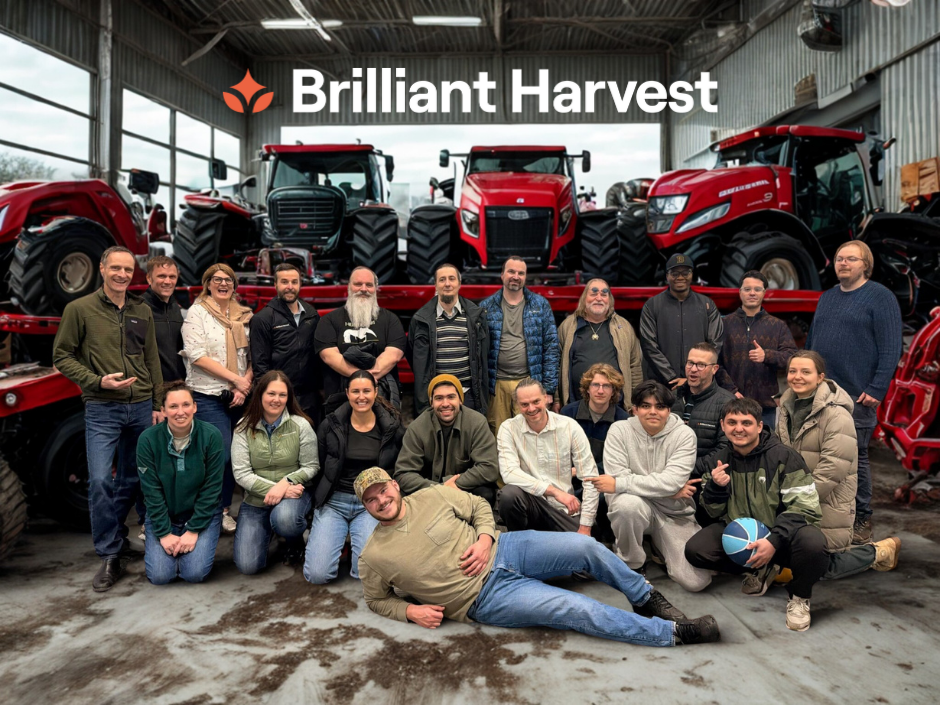
Fresh off a recent fundraising round and backed by leading investors like FTW Ventures, Alpaca VC, Automotive Ventures, SVG Ventures, NYA Ventures, Builders VC and AltaML, Brilliant Harvest is Brilliant Harvest is an AI customer experience platform for the heavy equipment industry that helps dealerships increase wrench time and service efficiency by turning complex technical data into instant, accurate answers for service, parts, and aftermarket teams.
Who is Remi?
I feel like I’m still figuring that out. I love adventures! I grew up on a farm, near a small farming community northeast of Calgary. My family’s been out there a hundred years now. I’ve successfully exited two agriculture companies previously, last one Decisive Farming was acquired by TELUS in 2019. I’m an entrepreneur; I like technology and figuring out how to apply technology within agriculture.
The first business I was in, my brother and I took over management from my father, in Ag Retail selling crop inputs to farmers. The business was struggling at the time, the role of the Ag Retail was changing - we came into a bit of a bloodbath of low margins. Along the way of figuring out how to keep that business alive, we realized that selling crop inputs was a tough business to be in. We took a segment of it, the agronomy side - how to grow crops more efficiently - and asked “how can we ensure consistent quality of agronomic services?”. This led us down the path of software and into the creation of Decisive Farming, with the leading question of “How do you scale an agronomist?”
Now with my latest company, Brilliant Harvest, the question is “how do you scale talent at the equipment dealership?”. Sales people, parts & support people, and technicians. We build a dealer branded AI platform with a proprietary knowledge base for the dealer made up of OEM manuals, work orders and tribal knowledge; enabling the dealers team to be more efficient and deliver a superior customer experience.
How do you find agriculture and tech have been playing off each other?
Farming is an asset-heavy business, becoming a new commercial farm isn’t really a thing anymore, getting into it fresh when a combine is $1mil USD is a tough endeavour. But, there’s never been a more important time to figure out how to get technology around agriculture adopted and it all starts with the dealer. A lot of tech is coming in from different industries and being re-appropriated for agriculture, and we want to find a way to successfully implement that tech in ag. The biggest challenge on the farm, you absolutely can’t risk losing a crop. You really only have 30 chances of having a good harvest in a lifetime. It’s not like manufacturing where you can tweak widgets being produced in a controlled environment. Our focus is scaling the dealership team, so they can provide the support and services a farmer needs to bring on new technologies on the farm that are reliable, and without downtime. An hour’s a big deal on the farm during harvest, and support from the dealer is important to a successful crop.
Do you think the idea of the ‘family farm’ is becoming less common? Who’s farming the land now?
Most of the farms in North America are still run by families. There’s a misnomer around corporate farms, and while these family farms are corporations, they’re still family businesses. The people owning them are working on them. The CEO, Executive Suite idea doesn’t work in Canadian farming; people have tried it and failed.
What’s happened is that, as land values have increased, you have a separation between owning the land and farming the land. Now, you have investors owning land, but know they won’t operate it as efficiently, so they’re finding farmers that have capacity in their existing operations to farm the land. There are economies of scale in farming, if I farm 3,000 acres, but the equipment I own can farm 5,000 acres, without buying any new equipment, I can farm more land. There has been separation on that front, but it’s no different than owning or renting your building as a business.
Why do you think you’ve stayed in the industry all this time?
It’s what I grew up around and what I know, and there’s a lot of inherent opportunity in that. Very few people know agriculture that well. There’s been $50 billion invested in consumer automotive software solutions; comparatively, very little has been invested in ag equipment software. There’s a massive opportunity with what we’re doing, and most people don’t understand or relate to it.
I find myself attracted to industries where the general consumer doesn’t quite get it. The percentage of people involved in agriculture in their normal life is really tiny. To be a successful entrepreneur here, you have to know the space and be connected, and I view my time in the industry as my competitive advantage.
I don’t know everything there is to know, but I know the people that can fill any knowledge gaps I have. Agriculture is so broad, ranging from genetics, to soil, software and robotics. That is all amplified by soil being the largest, living breathing organism on the earth and humans understand very little about it.
Why the decision to live out in Banff and how does that play out?
I’ve been living out there for 20 years now, and my wife was born there. After university, we had an opportunity to get a place in Banff. I was hesitant at the time, all I had really experienced before then was Banff Avenue, and I’m not a big crowd kind of guy. It’s actually a great place to live, the community is tiny and close-knit. You learn to ignore the tourists. Once you figure out the rules of living there, such as riding my bike most places and not driving across the bow river bridge on the Saturday of a long weekend, it’s a wicked place to live.
I have an investment fund, a startup, and I mentor startups, so living out in Banff means I can’t attend everything I’m invited to in the Calgary community, but I try to show up often and stack the meetings and events when I am in town.
My whole career has been remote. Even pre-Covid, I never worked in an office. I work better this way. It’s all about balancing how I work & my team works, the life I’ve built in Banff and still being present in Calgary where most of the team is based.
As an entrepreneur in general, whether you live in Calgary or Banff, you have to capitalize on the lulls in the business for yourself. There’s days when it’ll be a fresh 30cm powder day, my friends are all out skiing, but I gotta get some work done. But there’s also slower periods. It might be the calm before the storm, or the calm after, but you have to take that lull and find time for yourself. There’s been times in the business where a window opens up to disappear offline and I have capitalized on it by going skiing, paddling and other adventures.
You have to be conscious of taking time to recharge by turning off your phone when you can; there’s a balance of maintaining family, activities, and the business. There’s no one way to do it, and this has worked for me.
What has you excited about AgTech now?
I’m just excited to have such a great team at Brilliant Harvest, be backed by some of the best investors, and have a great opportunity to build a massive business. The market’s huge, Brilliant’s opportunity across Canada and the US is over $4billion, globally over $15billion. And we have all the ingredients of customers, capital and people to go after it.
What are you proud of?
I’m excited for my kids, watching them grow up, seeing who they become and what they get into. They’re all so unique and into different things - it’s amazing to watch. Their passions and interests and who they are. With what’s been happening in technology and the ability to adventure, I can’t wait to see what they do and what opportunities they find.
What comes next for Brilliant?
Our focus for 2026 is signing up the next 10 dealers, continuing to drive user adoption and revenue. There are a few openings on the engineering and AI team that we need to fill but overall we are ready to go being we are well capitalized. It’s just about executing and continuing to drive growth!